World generation and settlements
Towns, roads and wilderness give you different places to search. The seed and the world’s saved generation rules determine what you find.
Dimension profiles at a glance
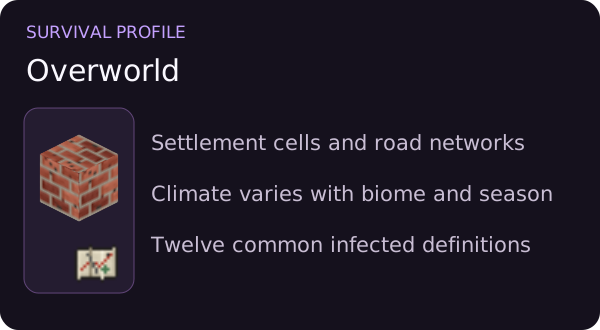
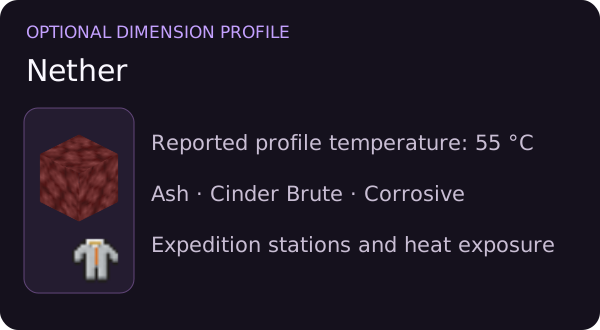
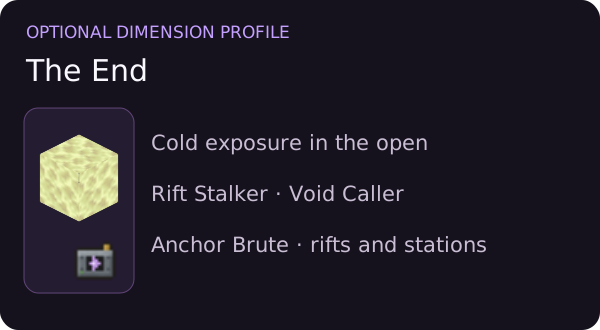
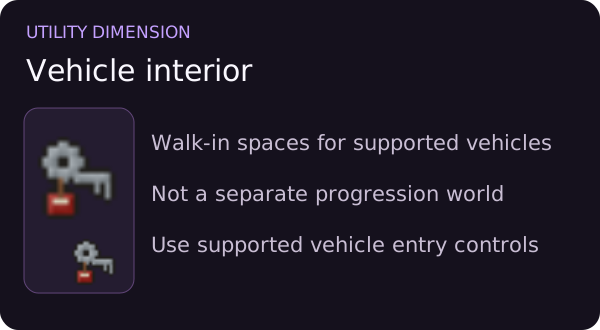
Explanatory cards using sourced item/block previews. These are not landscape screenshots or four newly added survival dimensions. Nether/End behavior requires the corresponding enabled profiles; vehicle_interior supports vehicle spaces. Climate, hazards and enabled-state details remain in the text. Sources: PDF pp. 25–28, 68, 207 and the credited 0.14.0/vanilla visual resources.
How settlements are planned
The Apocalypse preset uses 2,048-block cells mixing cities, towns, rural settlements and wilderness. Ordinary mode uses 1,024-block cells, fewer candidates and optional cities. Seeded region plans select streets, lots, named settlements, purpose sites and connecting roads; terrain and captured planning revision affect the result.
The report records 105 source building archetypes, not 105 imported whole-world maps. Homes, shops, medical/security sites, industrial buildings, farms, underground sites and transport facilities serve different generation and loot roles. Presence in the archetype list does not guarantee selection in a biome or seed.
Named cities include Cedar Junction, Greyhaven, Ironridge, Meridian, Breakwater and Halcyon Field under the named-city setting. Underground sites, radiation hazards, bridges, tunnels, causeways and highways are part of the broader planner/painter system, beyond the small set of packaged worldgen JSON files.
Revision-11 room dressing
Revision 11 can add whiteboards/notes, tabletop radios, record players, bicycles, planters, missing toilets, fires, bells, bulletins, book piles, burn barrels and sponges to eligible rooms. It preserves revision-10 lot plans. Doors, paths, support and reachable container fronts constrain placement.
| Eligible candidate | Reported chance |
|---|---|
| Classroom board / note | 85% / 60% |
| Police/fire briefing board / note | 100% / 85% |
| Office board / note | 25% / 45% |
| Lab board / note | 30% / 60% |
| Living-room radio / record player | 30% / 20% |
| Garage / yard bicycle | 35% / 12% |
These are candidate chances before eligibility and geometry checks, not independent guarantees that every room receives a piece. An updated JAR does not retrofit this dressing into an older world’s plan.
Dimensions and found material
The Nether and End add profiles, hazards, infected and expedition/survey routes when enabled. A separate interior dimension supports walk-in vehicle spaces; it is not a replacement survival world.
Environmental scenes, original room notices and The Long Light’s campaign story are distinct systems. The discovery catalog contains found-material spoilers and archetype records. Decorative board text is not automatically a quest or a functioning direction to a target.
The author-reported 760-building survey was not repeated. Difficult terrain and small/off-grid pond probes remain placement limits; no new seed guarantee or whole-map rotation support is claimed.
Report illustration
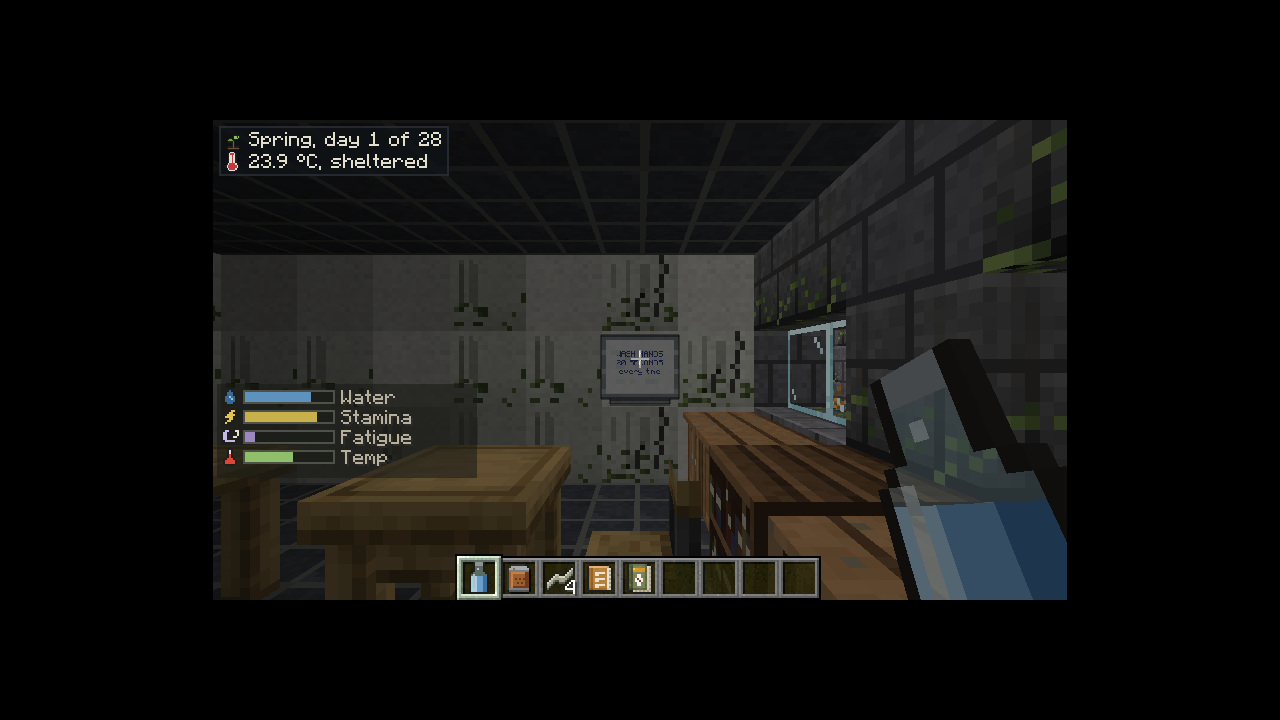
Existing developer capture reported as 0.14.0; supplied report p. 34, E077. Does not establish placement on an arbitrary seed or a new generation run. Credit: existing Afterfall developer capture reproduced from the supplied report.
Admin & server owner reference
Original fields and wording
The packaged vehicle_interior dimension supports walk-in vehicle spaces
Sources & verification
Evidence: pdf-derived. Feature status: implemented-static. Article coverage: ready.
PDF pages 27–34, 207, 209 · 12 World generation; 30 Dimensions; 31 Limits · Afterfall 0.14.0 report: E017–E018, E077–E083, E181–E186
Gameplay prose remains report-derived and has not been newly playtested. Visuals use directly inspected 0.14.0 resources or explicitly historical captures as credited; pack overrides remain unknown.
The wiki has not independently playtested report-derived instructions. Your server or modpack settings may change them.